As an SEO professional, I have seen many times how powerful search engine optimization can be for online businesses. If you are learning about SEO, you have probably heard the term many times. Yet, you may still wonder what SEO really means, how it works, and why it matters for the growth of an online business.
In this comprehensive guide, we will go beyond a simple definition of SEO. We will explore the key aspects of search engine optimization, from the basics to more advanced strategies, the main pillars of SEO, and the trends shaping its future.
The goal is to give you a clear overview of SEO. By the end of this guide, you should understand how SEO works and have a solid foundation for applying it to your own website.
Let’s start by exploring the world of SEO.
1. What Is SEO? Definition and Core Principles.
First, let’s start with the most basic question: what is SEO?
SEO stands for Search Engine Optimization. In simple terms, SEO is the process of improving a website or web page so it can rank higher on search engine results pages (SERPs), such as Google, Bing, and Yahoo.
The main goal is to help your website appear as high as possible, often on the first page, for keywords and search queries related to your content, products, or services.
When your website ranks higher, more people are likely to see it, click on it, and visit your site. However, this is only the surface of SEO. SEO is not simply about trying to “beat” or manipulate search engine algorithms. At its core, SEO is an ongoing process that focuses on three key areas:
- Understand your users: You need to understand what your potential customers are searching for, which keywords they use, and what they are actually trying to find when they search.
- Understand search engines: You also need to understand how search engines work, how they evaluate and rank content, and what guidelines they use when deciding which pages to show.
- Provide real value: Most importantly, you need to create high-quality, useful, accessible, and trustworthy content that meets users’ needs while making it easier for search engines to understand and index your website.
In other words, SEO is the practice of improving your website's visibility in search engine results. It helps you reach the right audience at the right time while creating value for both users and your business.
2. Why Is SEO Important for Businesses?.
There are many different digital marketing strategies available today. However, SEO can be one of the most sustainable ways to build long-term visibility online.
Here are some of the main reasons why SEO matters.
2.1 Increase visibility and organic traffic
When your website appears near the top of Google search results, it can attract visitors who are actively searching for information, products, or services that you offer.
This traffic is known as organic traffic. Unlike paid advertising, you do not pay for every click from organic search results. Because users are actively searching for something related to your business, organic traffic can also be highly relevant. In my experience, SEO becomes much more valuable when organic traffic is connected to real business goals, rather than treated as a traffic metric alone.
2.2 Build credibility and trust
When your website consistently appears among the top search results, users may begin to see your business as a reliable source of information. A strong search presence can support your brand credibility and help build trust with potential customers.
Higher visibility does not only bring more visitors. It can also strengthen how people perceive your brand within your industry.
2.3 Deliver long-term cost efficiency
SEO requires time, effort, and investment, especially in the early stages. However, once your website achieves strong rankings, it can continue to generate traffic without requiring you to pay for every visit, as you would with paid advertising campaigns. This makes SEO a long-term investment that can continue creating value over time.
2.4 Understand your customers through data
SEO is not only about technical optimization. It also involves researching keywords and understanding user behavior. Tools such as Google Analytics, Google Search Console, Ahrefs, and SEMrush can help you understand what people are searching for and what topics they care about. These insights can then help you improve your content, products, and services.
2.5 Build a sustainable competitive advantage
The online market is increasingly competitive. A strong SEO strategy can help your business build a long-term presence in search results. Paid advertising can provide immediate visibility, but it usually requires ongoing spending to maintain that visibility. A strong SEO foundation, on the other hand, can continue supporting your website’s visibility over time.
3. How Do Search Engines and SEO Work?.
Now that we understand what SEO is and why it matters, the next step is to understand how search engines find, understand, and rank web pages.
In practice, some of the biggest SEO opportunities I have seen come from fixing technical issues that prevent good content from being properly crawled, indexed, or ranked.
Most search engines follow three key processes:
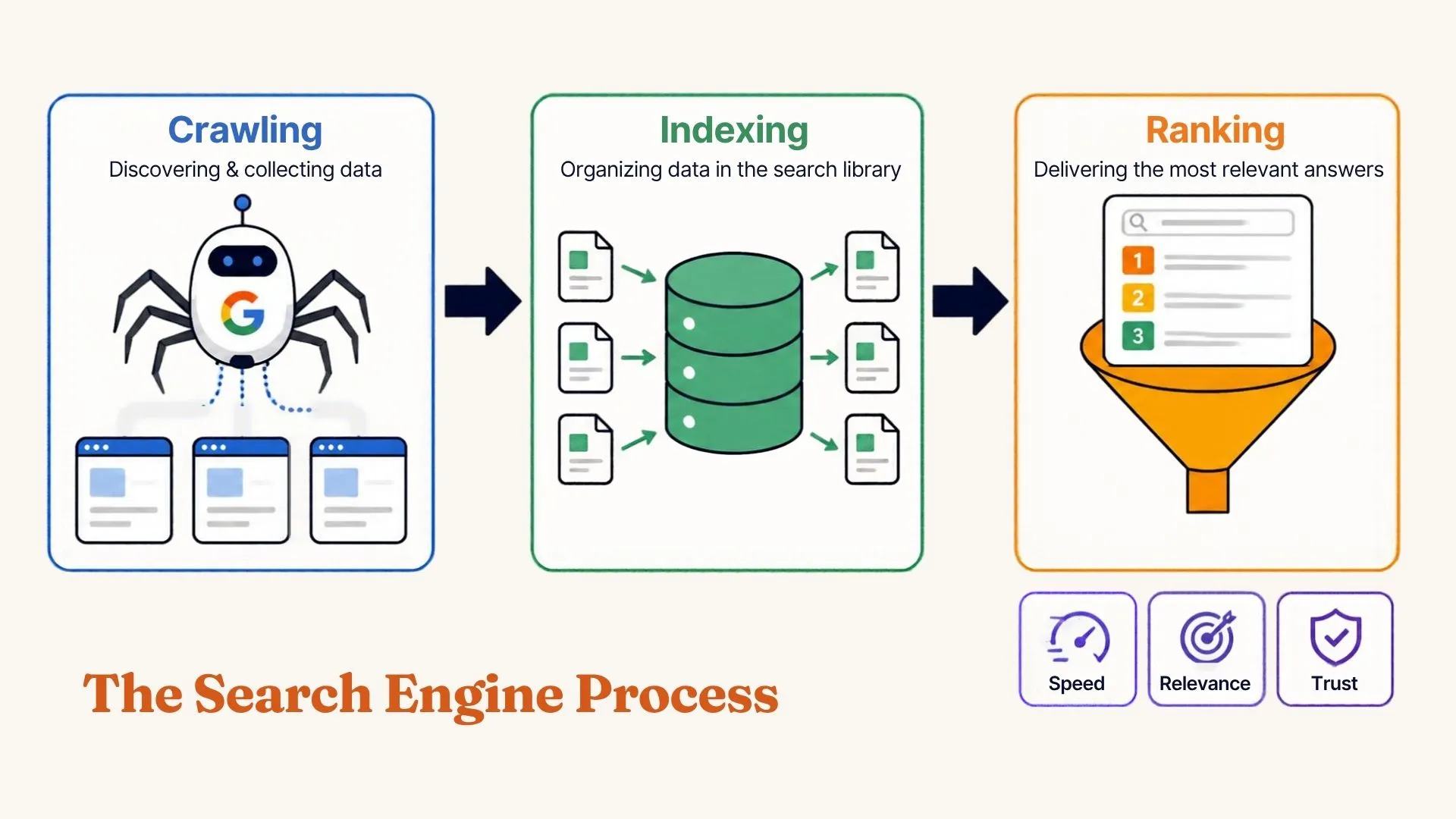
Understanding these three steps makes it easier to see where SEO fits into the search process.
3.1 Crawling (data collection)
Search engines use automated programs called bots, spiders, or web crawlers to discover information across billions of web pages. These crawlers move from one page to another through links. They read and collect information from pages, including text, images, videos, and other elements.
→ The role of an SEO professional: Make sure your website can be easily crawled by search engine bots. This involves areas such as website structure, the robots.txt file, XML sitemaps, and internal links.
3.2 Indexing (organizing the data)
After crawling a page, search engines analyze and try to understand its content. They then store this information in a large database called an index. You can think of the index as a huge library. Instead of searching the entire internet every time someone enters a query, search engines can use this organized database to find relevant pages more efficiently.
→ The SEO’s role: Make sure your content is clear, well-structured, and easy for search engines to understand. This includes using relevant keywords and avoiding technical issues that can prevent pages from being indexed, such as an incorrect noindex directive.
3.3 Ranking (ordering the results)
When someone enters a search query, the search engine looks through its index to find pages that are relevant to that query. It then uses many different ranking signals to determine which pages should appear and in what order. The goal is to provide users with results that are as relevant and useful as possible.
→ The role of an SEO expert: Optimize the website and its content based on known search engine guidelines and ranking factors to improve its visibility in search results. This is where many SEO activities come together.
4. The 4 Main Pillars of a Comprehensive SEO Strategy.
A strong SEO strategy combines several areas that work together. For this guide, we can divide SEO into four main pillars:
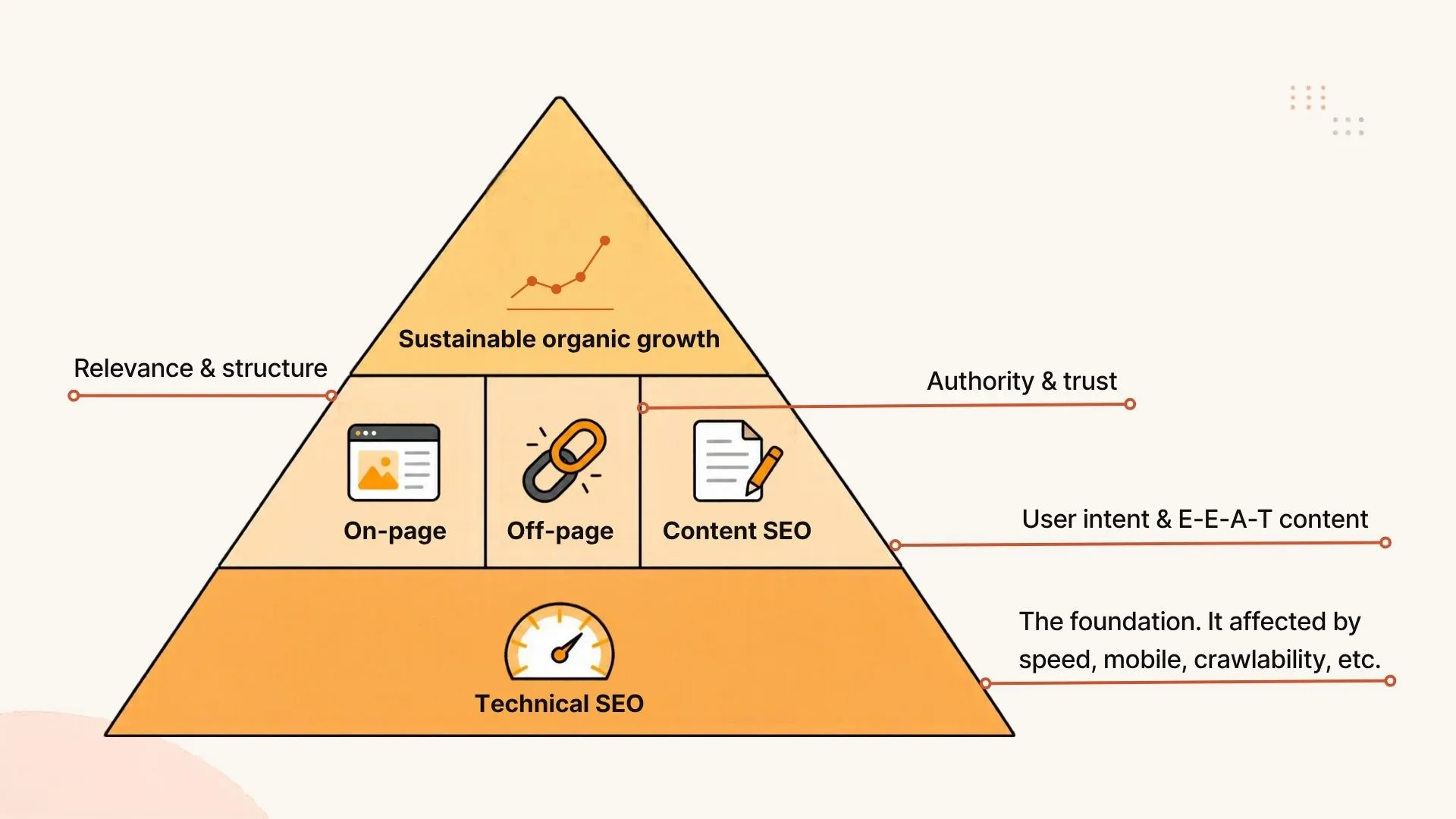
Each pillar plays a different role in improving your website’s visibility and performance.
| Pillar | Core Focus | Primary Objective |
|---|---|---|
| 4.1 Technical SEO | Site Architecture, Speed & Indexing | Ensures search engine bots can seamlessly crawl, index, and render pages. |
| 4.2 On-page SEO | Page Elements, Keywords & Meta Tags | Optimizes title tags, headings, alt text, and internal links for search relevance. |
| 4.3 Off-page SEO | Backlinks & Brand Authority | Builds external domain trust, link quality, and local Google Business profile signals. |
| 4.4 Content SEO | Search Intent & E-E-A-T Quality | Delivers authoritative, high-value content that matches exact user search intent. |
4.1 Technical SEO
Technical SEO provides the foundation for your SEO strategy. It focuses on improving the technical structure of your website so that search engines can crawl, index, and understand your content more easily.
In my experience, technical SEO issues are often easy to overlook because they may not be visible to users, yet they can have a significant impact on organic performance.
Key areas include:
- Page speed: A fast-loading website can improve the user experience and is an important search ranking factor.
- Mobile-friendliness: Search engines prioritize websites that work well on mobile devices as part of their mobile-first approach.
- Website structure: A clear and logical structure helps search engine bots navigate your website and understand how different pages are connected.
- HTTPS: Using HTTPS helps protect users and provides a secure connection between the website and its visitors.
- Schema markup: Structured data helps search engines better understand the information on your pages and can support enhanced search results.
- Robots.txt and XML sitemap: These files help guide search engine crawlers and make it easier for them to discover and crawl your website.
Technical SEO can become complex, especially for larger websites. However, its basic purpose is simply to make your website easier for search engines to access and understand.
4.2 On-page SEO
On-page SEO focuses on optimizing the content and structure of individual pages on your website. The goal is to improve their relevance and visibility for the searches that matter to your audience.
Key areas include:
- Keyword research: Identify the keywords and search queries your target audience uses.
- High-quality content: Create original, useful, and in-depth content that provides real value and addresses users’ questions or problems.
- Title tags: Create clear and engaging page titles that accurately describe the content and include the primary keyword when appropriate.
- Meta descriptions: Write useful and compelling descriptions that summarize the page and encourage users to click.
- Heading tags: Use H1, H2, H3, and other headings to organize your content and make it easier for both users and search engines to understand.
- Image optimization: Use descriptive alt text and compress image files to improve accessibility and page loading speed.
- Internal linking: Add relevant links between related pages on your website. This helps users discover more content and helps search engines understand the relationship between your pages.
4.3 Off-page SEO
Off-page SEO covers activities outside your own website that can help strengthen its credibility, authority, and visibility. One of the best-known areas of off-page SEO is link building.
Key areas include:
- Link building: Earn quality backlinks from reputable websites. Backlinks are links from other websites to your own site and can be an important ranking signal.
- Social media marketing: Social media activity is not usually treated as a direct ranking factor. However, sharing content on social platforms can increase visibility and may help attract links and visitors.
- Google Business Profile: Optimizing your Google Business Profile is important for local SEO. It can help your business appear in Google Maps and local search results.
- Brand mentions: When your brand is mentioned on other websites, blogs, or forums, even without a link, it can contribute to your overall online presence.
Off-page SEO is largely about building signals beyond your own website that support your brand’s credibility and visibility.
4.4 Content SEO
Content is at the heart of any SEO strategy. Even a technically strong website will struggle to perform well if it does not provide useful content for its audience.
Content SEO includes several key areas:
- Content strategy: Plan and create different types of content, such as blog posts, long-form articles, infographics, and videos, to address different stages of the customer journey.
- E-E-A-T: Google increasingly emphasizes the importance of demonstrating Experience, Expertise, Authoritativeness, and Trustworthiness in content.
- Updating existing or old content: Review and improve older content regularly to keep it useful, accurate, and relevant.
- Search intent: Make sure your content addresses the reason behind a user’s search, rather than simply including the target keyword.
One lesson I have learned through SEO work is that matching search intent is often more important than simply including the right keywords. For example, someone searching for a product may want to buy it. Another person may be looking for information, while someone else may want to compare several options.
Understanding that difference helps you create content that actually matches what users need.
5. Common SEO Myths.
After understanding the basic structure of SEO, it is also important to clear up some common misconceptions.
Over the years, I have encountered many misunderstandings about how SEO works. Here are some of the most common ones.
5.1 SEO is a one-time project
This is not true. SEO is an ongoing process. Search engines change, competitors publish new content, user behavior evolves, and websites need regular monitoring and optimization. A strategy that works today may need to be adjusted in the future.
5.2 SEO is all about keywords
Keywords are important, but SEO goes far beyond keywords. A complete SEO strategy can involve technical optimization, content, links, website structure, user experience, and many other factors.
In my experience, one of the biggest SEO mistakes is treating SEO as a content-only activity. Good content matters, but it needs to work together with the technical foundation, website structure, authority, and overall user experience.
5.3 SEO is about finding ways around Google
Black-hat SEO techniques may sometimes produce quick results, but they are not a sustainable approach. Some practices can violate search engine guidelines and may put your website at risk of ranking losses or other penalties. A sustainable SEO approach focuses on creating real value for users and following search engine guidelines.
5.4 SEO is only for developers
SEO does include technical elements, but you do not need to be a professional developer to work in SEO. It also requires skills in content, marketing, data analysis, user behavior, and communication. Technical knowledge can be especially useful for Technical SEO, but it is only one part of the wider discipline.
5.5 SEO and GEO are the same
As AI-powered search becomes more common, some businesses may wonder whether they should replace SEO with GEO (Generative Engine Optimization). This is a misconception.
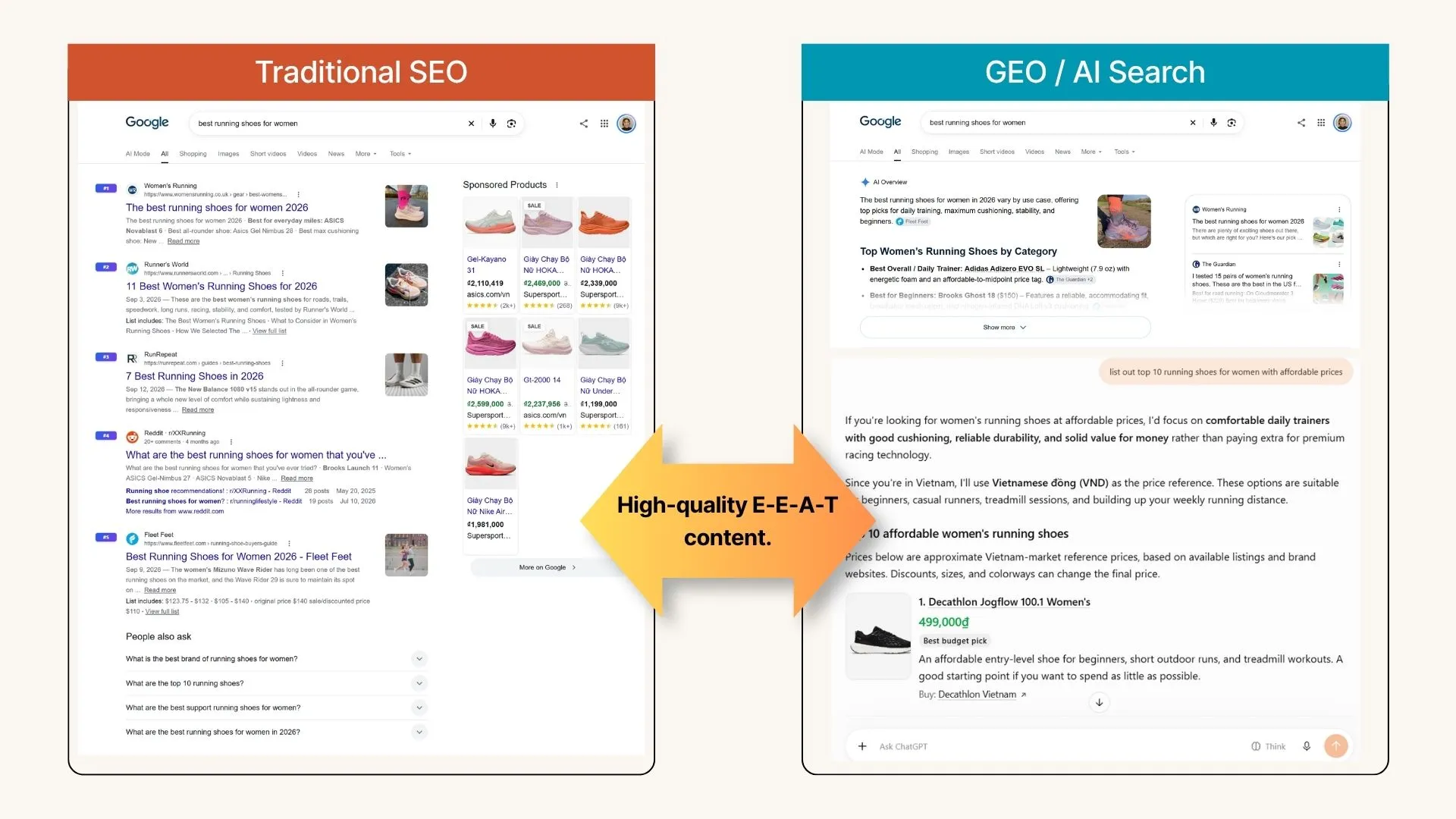
SEO and GEO have different focuses, but they share many core principles, including useful content, clear structure, relevance, and trust. SEO focuses mainly on visibility in traditional search results, while GEO focuses on increasing the chances that content is understood and referenced by AI-powered search systems.
Therefore, GEO should be viewed as an extension of SEO, not a replacement for it. A strong SEO foundation can also support your GEO efforts as search continues to evolve.
6. Which Metrics Matter & How to Measure SEO Performance.
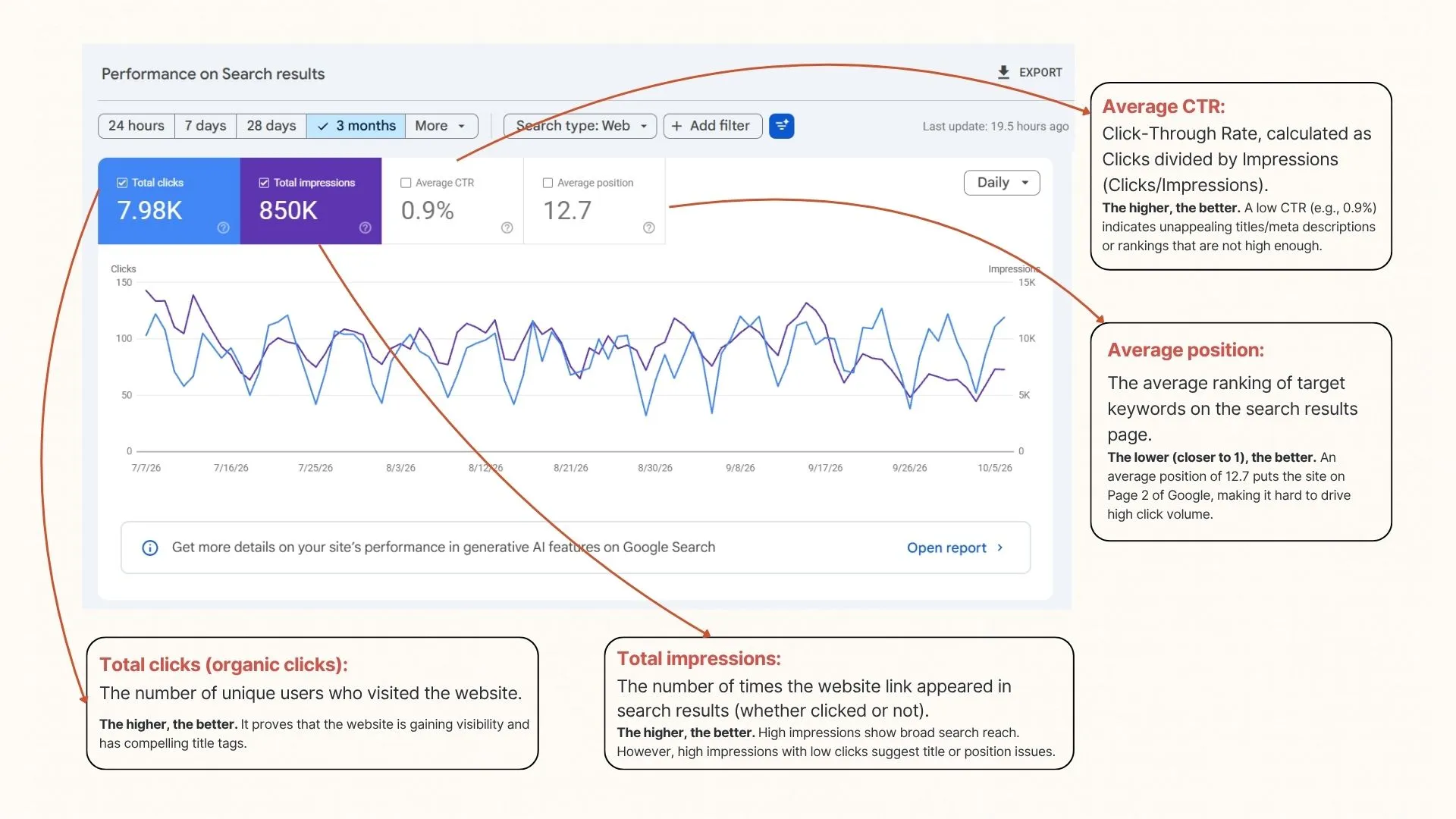
To know if your strategy is working, measurement is essential because SEO should be guided by data rather than assumptions. In my experience, single SEO metric does not tell the full story. Rankings, organic traffic, engagement, and conversions need to be looked at together.
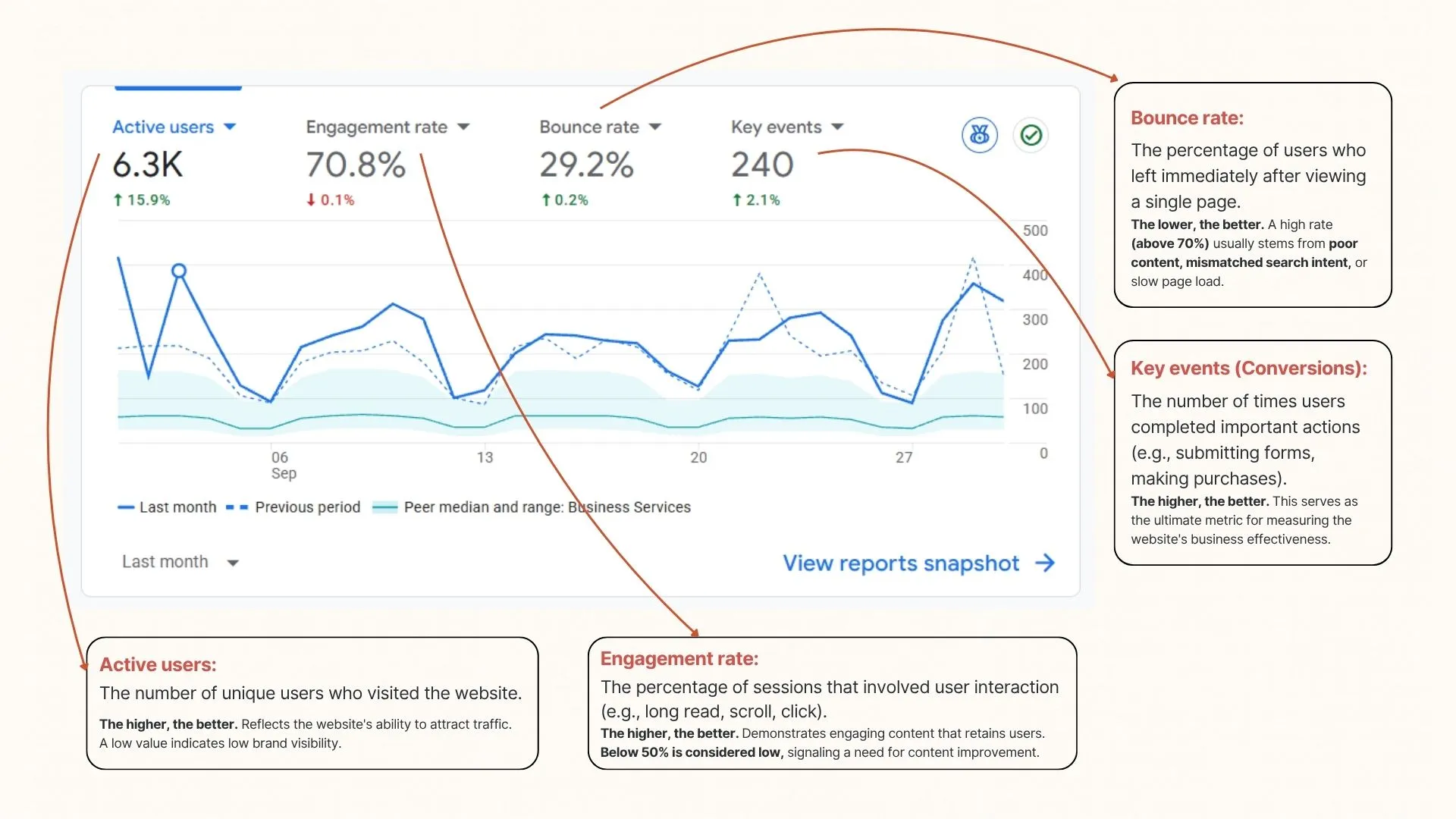
Here are some key metrics to monitor.
- Organic traffic: The number of visits your website receives from organic search results.
- Keyword rankings: The positions of your target keywords in search results.
- Click-Through Rate (CTR): The percentage of users who click your search result after seeing it in the SERP.
- Bounce rate: The percentage of users who leave after viewing only one page. A lower bounce rate can sometimes indicate that users find the content relevant, although this metric should always be interpreted in context.
- Conversion rate: The percentage of users who complete a desired action, such as making a purchase, submitting a form, or signing up.
- Backlinks: The number and quality of external links pointing to your website.
- Domain Authority (DA) and Domain Rating (DR): These are third-party metrics used by tools such as Moz and Ahrefs to estimate the authority or strength of a website or domain. They can be useful for analysis, but they are not official Google ranking scores.
Essential tools for tracking include Google Analytics, Google Search Console, Ahrefs, and SEMrush.
7. Final Thought: What to Remember About SEO.
I hope this guide has given you a clearer understanding of what SEO is, how search engines work, and why search engine optimization matters for businesses. SEO is a constantly evolving field that requires patience, analysis, creativity, and a strong understanding of users.
The ultimate goal of SEO is to create real value for your audience rather than trying to beat search engine algorithms. When you focus on useful content, a strong user experience, and responsible SEO practices, you can build a more sustainable search presence over time.
Keep learning, keep testing, and always put your users first. The SEO journey can be challenging, but the rewards for your business are absolutely worth it.
Wishing you great success on this journey!
8. Frequently Asked Questions About SEO.
8.1 How long does SEO take to show results? +
In many cases, you may start seeing meaningful results after around 3-6 months. Ranking for highly competitive keywords can take 6-12 months or longer. The timeline depends on factors such as industry competition, website condition, content quality, authority, and the resources invested in SEO.
8.2 Do you need to know how to code to do SEO? +
You do not need to be a professional developer to work in SEO. However, a basic understanding of HTML, CSS, and JavaScript can be a major advantage, especially when working with Technical SEO. Other areas, such as content SEO and link building, require little or no coding knowledge.
8.3 Does Google penalize black-hat SEO? +
Yes, Google takes action against practices that violate its guidelines. Examples include keyword stuffing, cloaking, and manipulative link schemes. If a website is found to be using such practices, its visibility may be significantly reduced or, in some cases, pages may be removed from Google’s search index.
8.4 Can SEO be used for every type of website? +
Yes, SEO can be applied to many types of websites, including personal blogs, business websites, e-commerce stores, online publications, and web applications. The specific strategy will depend on the website, its audience, its goals, and its industry.
8.5 Is SEO dead? +
The idea that “SEO is dead” has appeared many times over the years. In reality, SEO continues to evolve. As long as people use search engines to find information, products, services, and answers, there will be a need to understand how search works and how websites can be discovered through it. What changes is the way SEO is practiced and the factors that receive the most attention.
8.6 What is the difference between SEO and SEM? +
SEM, or Search Engine Marketing, is a broader term related to marketing through search engines. SEO focuses on earning visibility through organic search results, while PPC (Pay-Per-Click) focuses on paid advertising. In simple terms, SEO aims to attract organic traffic, while PPC involves paying for advertising placements and clicks.